On a fogbound morning in October 1776, British cannon fire thundered across Lake Champlain. Through the smoke and mist, gunners aboard the British fleet believed they were pounding one of Benedict Arnold’s retreating warships.
Their target never moved. It never returned fire. It did not sink.
When the fog finally lifted, the British discovered that they had been bombarding a rocky island.
The formation they had mistaken for an enemy vessel still rises from the waters southwest of South Hero. Known today as Carleton’s Prize, the isolated rock preserves one of Lake Champlain’s most enduring Revolutionary War stories, a tale in which fog, black-powder smoke and mistaken identity may have helped Benedict Arnold’s battered fleet gain precious time.
Yet the rock had a name and a story long before British warships appeared on the lake. To the Abenaki, it was associated with Odzihozo, the powerful Transformer who shaped the Champlain Valley.
A Rocky “Warship” in Crescent Bay
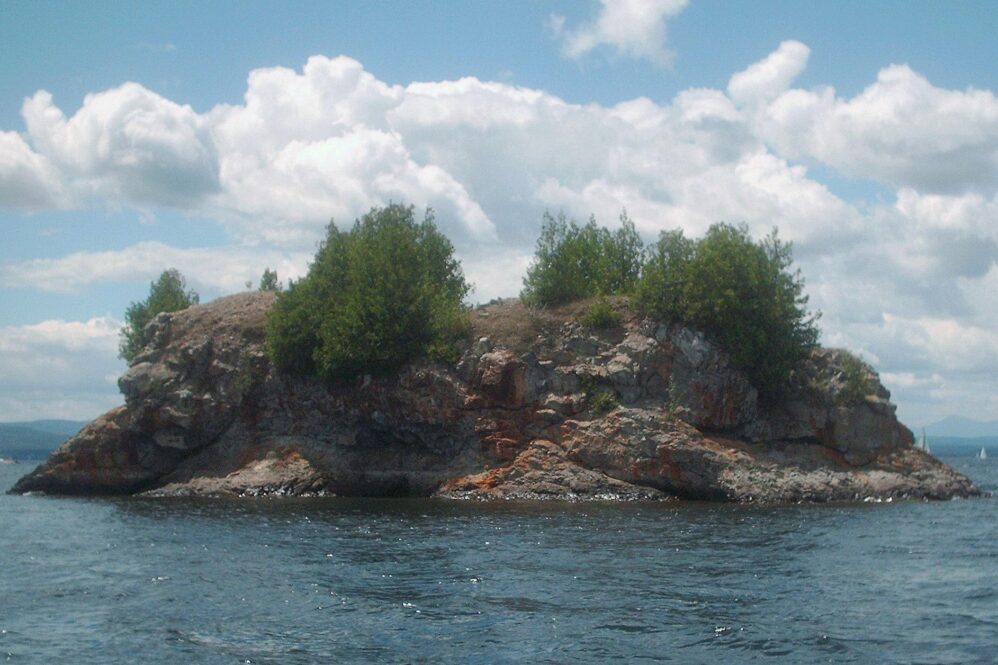
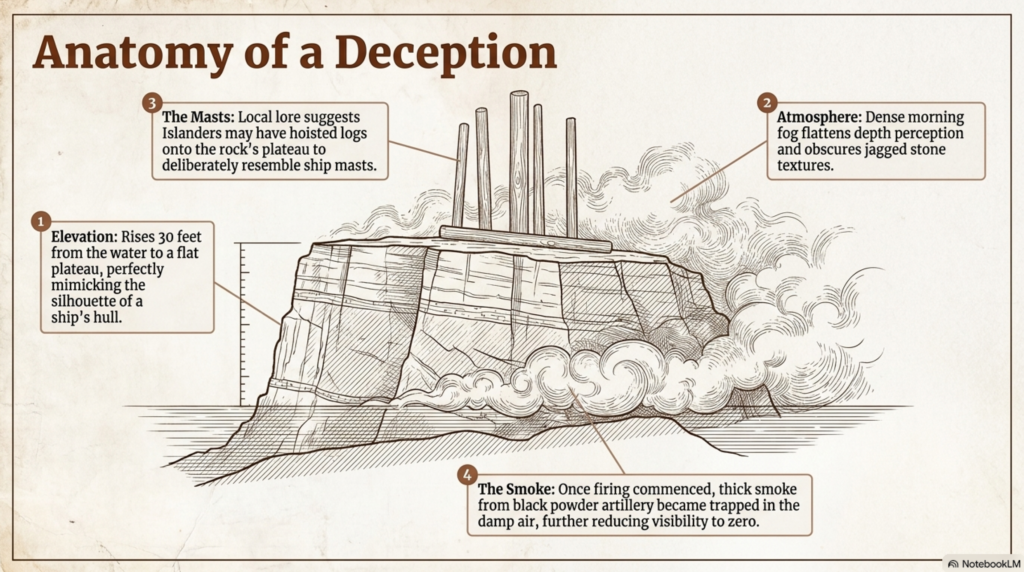
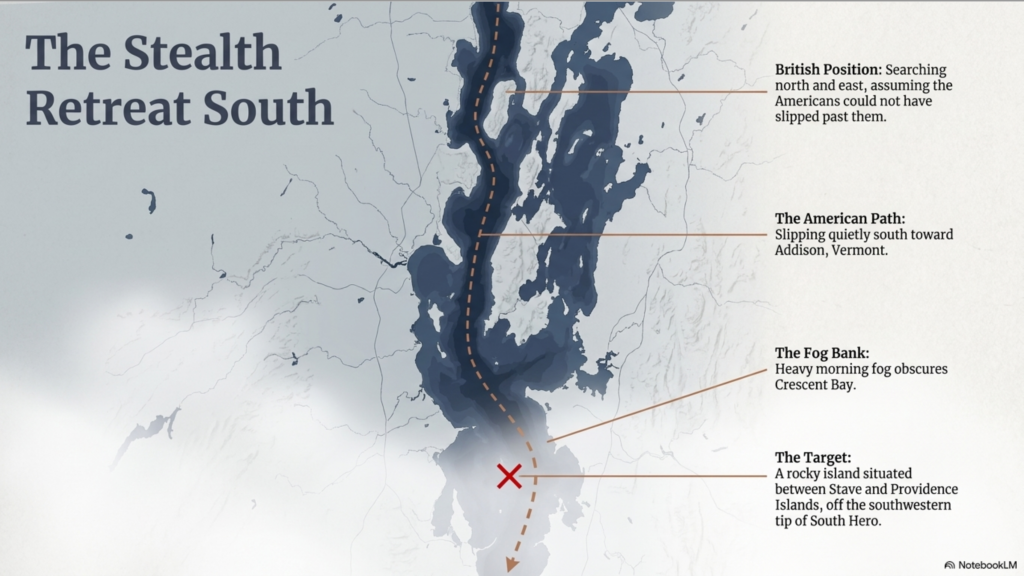
Carleton’s Prize is a small, steep-sided rock island in Crescent Bay, off the southwestern end of South Hero, Vermont. It lies between Stave Island and Providence Island and rises approximately 30 feet from the water to a relatively level summit. From a distance, particularly in poor visibility, its dark profile can resemble the hull of a vessel sitting low on the lake.
That resemblance is central to the story of how the island acquired its unusual English name.
The event is said to have occurred on the morning of October 12, 1776, one day after the Battle of Valcour Island. During that battle, an improvised American fleet commanded by General Benedict Arnold confronted a larger and more heavily armed British force on Lake Champlain.
The Americans suffered serious losses, and the British won the tactical engagement. Nevertheless, Arnold’s resistance slowed Britain’s southward campaign and helped delay a major invasion until the following year. That delay contributed to the circumstances that eventually led to the American victory at Saratoga in 1777.
Arnold’s Escape Through the Darkness
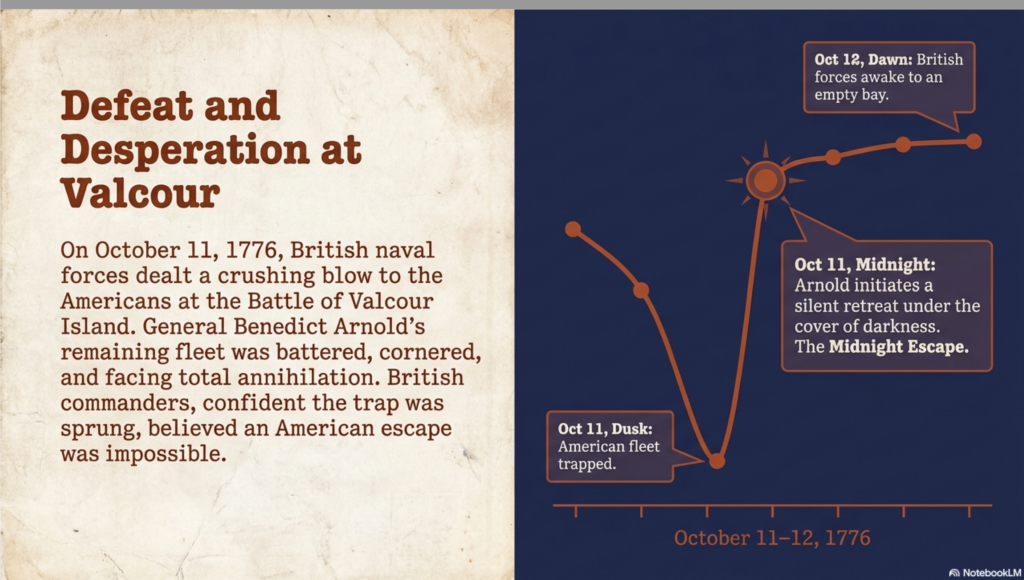
As daylight faded after the Battle of Valcour Island, the surviving American vessels appeared trapped. British commanders believed Arnold’s fleet had little chance of escaping.
Arnold, however, took advantage of the darkness.
With oars muffled and lights extinguished, the remaining American vessels slipped through the British line during the night. By morning, the Americans had put several miles between themselves and Valcour Island. National Park Service and naval-history accounts confirm that Arnold’s surviving force escaped under cover of darkness and continued retreating southward along the lake.
According to the Carleton’s Prize tradition, the British did not initially believe that Arnold could have passed them unseen. When they began searching through the heavy morning fog, they looked toward the north and east.
There, through the mist, they saw what appeared to be a motionless American warship.
The Cannons Open Fire
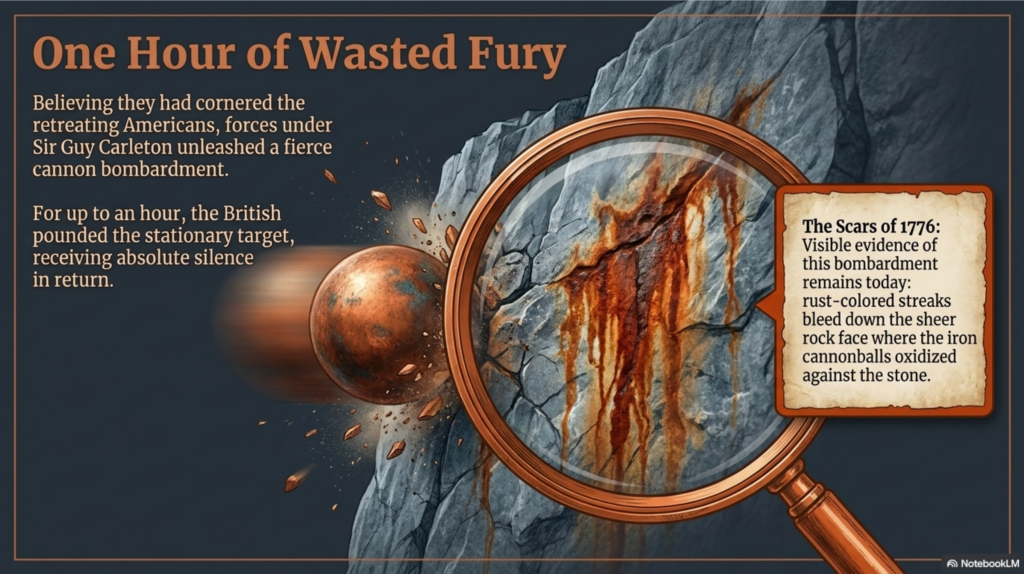
British forces under General Guy Carleton reportedly turned their guns toward the shape and opened fire.
The first cannon blasts would have filled the air with thick smoke. Eighteenth-century naval artillery used black powder, producing clouds that could obscure targets even under clear conditions. In fog, each volley would have made it increasingly difficult for the gunners to see what they were attacking.
Still, the supposed American vessel did not respond.
The British continued firing, according to the most familiar version of the story, for as long as an hour. Only when the fog thinned, or a breeze cleared away the smoke, did the crews realize that they had been bombarding a rock rather than one of Arnold’s ships.

The mistake gave the formation its lasting name. It was Carleton’s Prize, a mocking reference to the “enemy vessel” General Carleton had supposedly captured.
Local tradition adds another intriguing detail. Some versions claim that residents of the Champlain Islands placed logs upright on the rock so that they resembled masts, deliberately encouraging the British misidentification.
It is a wonderful addition to the story, but it should be regarded as folklore rather than established fact. No widely cited contemporary British or American account has been found that confirms the bombardment in all its familiar details, much less the placement of false masts. The episode survives principally through local histories and traditions repeated around the Champlain Islands.
Did the Mistake Save Arnold’s Fleet?
The bombardment is often described as a distraction that allowed Arnold and his men to escape farther south.
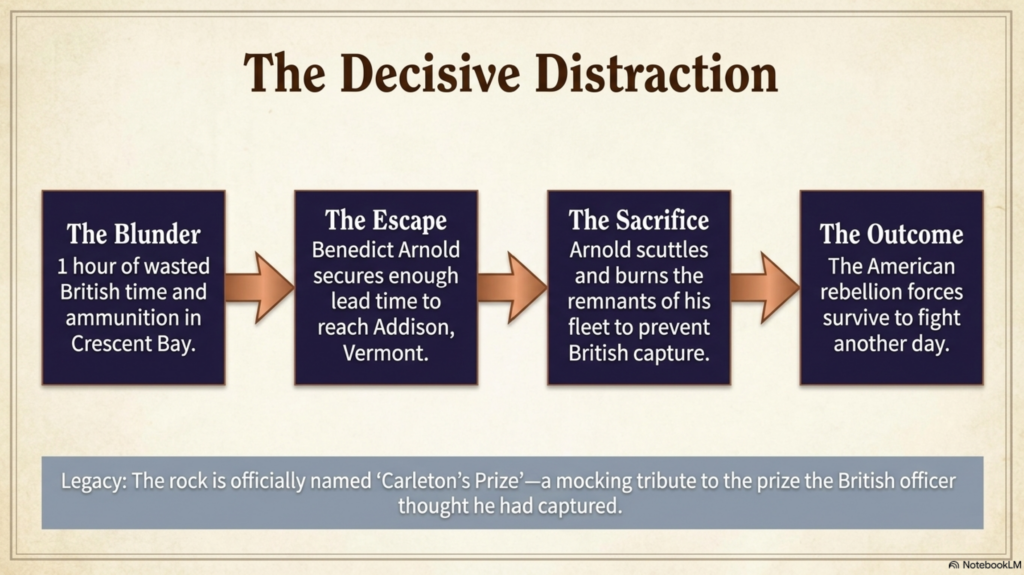
That interpretation may give the rock too much credit. Arnold had already slipped past the British fleet during the night, and the pursuit continued after daylight. The surviving American vessels did not escape intact.
British forces caught up with Arnold’s retreating fleet on October 13. Near what became known as Arnold’s Bay in Panton, Vermont, Arnold ordered several of his remaining vessels run ashore and burned rather than allow them to be captured. He and many of his men then continued overland toward the American defenses at Crown Point and Fort Ticonderoga.
Carleton’s Prize, therefore, should not be credited as the sole reason Arnold escaped. At most, the reported cannonade may have consumed time and added confusion while the British attempted to determine where the Americans had gone.
Even without the legendary bombardment, Arnold’s retreat was remarkable. His fleet had been defeated, but his resistance forced the British to spend valuable time constructing ships, fighting for control of Lake Champlain and pursuing the survivors. By the time Carleton reached the American fortifications farther south, the season was too advanced for him to continue the campaign safely. The British withdrew to Canada and postponed their major advance until 1777.
Cannonball Scars on the Rock
Visitors and boaters have long reported seeing reddish or rust-colored streaks running across portions of Carleton’s Prize.
Tradition holds that these marks were left where British cannonballs struck or scraped the rock. Photographs do show prominent orange and reddish discoloration on the island’s face. Whether each streak can be conclusively connected to cannon fire is another matter. Most likely, they are pockets of iron ore embedded into the rocks for millions of years. Natural mineral staining and weathering may account for most of the color.
Nevertheless, the visible marks have helped keep the story alive. When viewed from the water, they seem to offer physical evidence that something violent once occurred there.
The island is now conserved, helping protect both its natural character and its place in Lake Champlain history.
Odzihozo’s Wife
The Revolutionary War story is only the most recent layer of meaning attached to the formation.
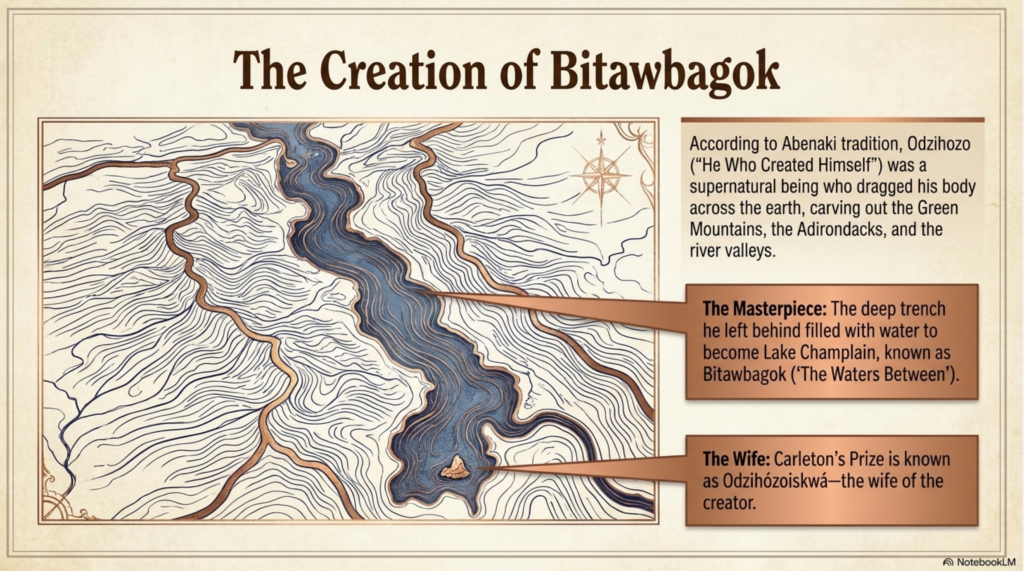
Long before it became Carleton’s Prize, the Abenaki knew the rock by a name recorded as odzihózoiskwá, commonly translated as “Odzihozo’s wife.”
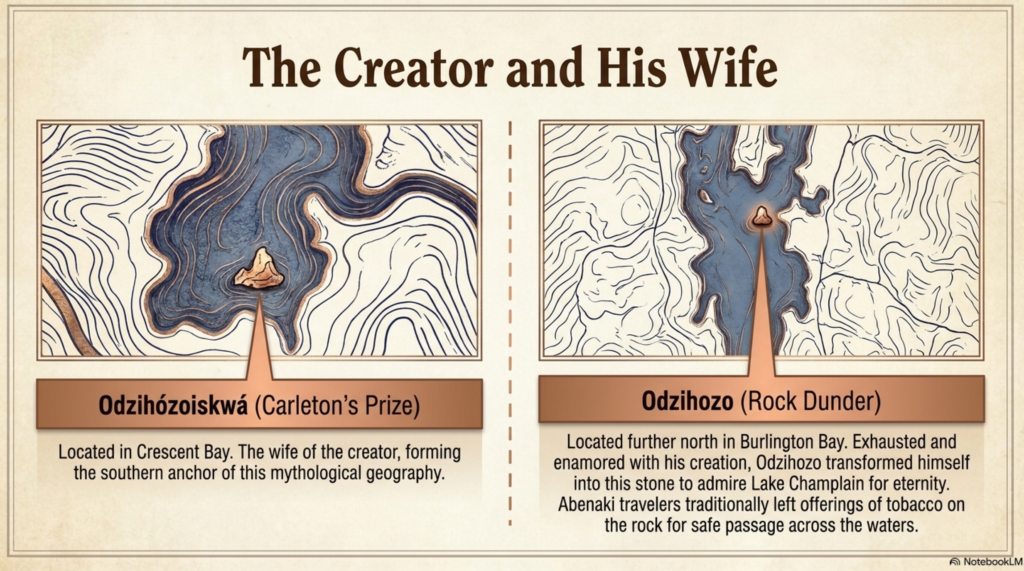
Odzihozo is the Transformer, often described as “He Who Shaped Himself.” In Abenaki tradition, he formed his own body and then shaped the landscape around Lake Champlain. With his hands, he raised the Green Mountains and the Adirondacks. The impression of his body became the lake, while his movements formed valleys, waterways and other features of the region.
Carleton’s Prize was associated with his wife.
This older name places the rock within an Abenaki cultural landscape rather than treating it merely as a curiosity from the American Revolution. The formation was already part of a much deeper story about the creation of the lake and the living relationship between the region’s people and its natural features.
A Similar Legend at Rock Dunder
Curiously, another Lake Champlain tradition tells of British forces firing upon Rock Dunder after mistaking it for a vessel in the fog.
After completing his work, Odzihozo is said to have transformed himself into stone at Rock Dunder, the distinctive formation in Lake Champlain west of Shelburne.
Some versions connect that event with the Revolutionary War. Others place it during the War of 1812 and associate it with the Battle of Plattsburgh. The similarities raise an obvious question: Did British forces make the same mistake twice, or did one lake legend gradually become attached to two different rocks?
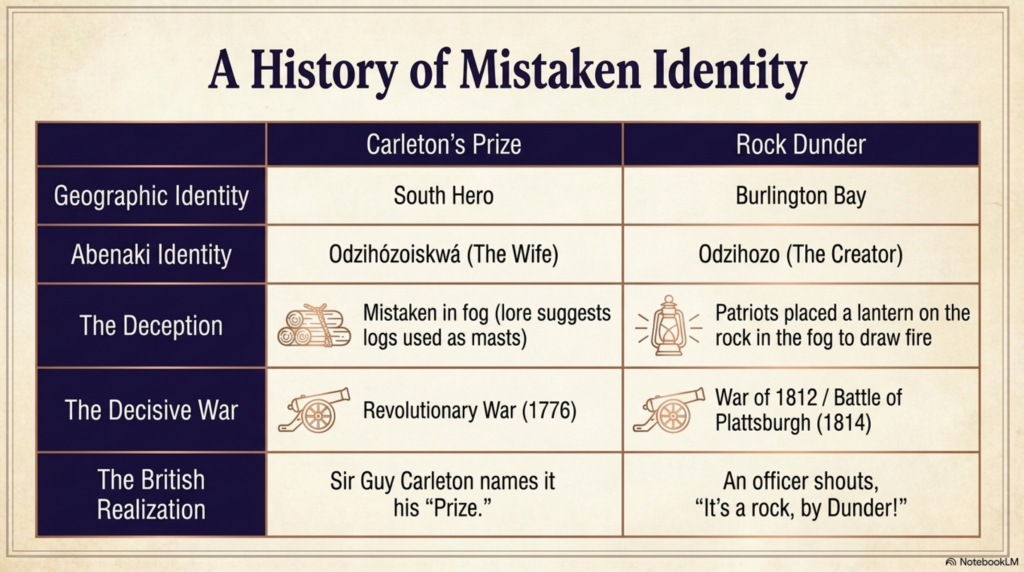
There is no certain answer.
Stories carried by generations of boaters, fishermen and island residents frequently change as they are retold. Names move. Dates shift. Details from one historical event become attached to another place. The cannonade associated with Carleton’s Prize may preserve an actual event, an embellished event or a piece of folklore that traveled across the lake.
That uncertainty does not make the story meaningless. It simply asks us to distinguish between documented military history and the traditions through which local communities remember the past.
The Prize That Never Fired Back
Today, Carleton’s Prize sits quietly in the open water beyond South Hero. Shrubs and small trees cling to its plateau. Waves strike its rocky base, and reddish stains remain visible along its weathered sides.
From a nearby shore, it is difficult to imagine anyone mistaking it for a warship.
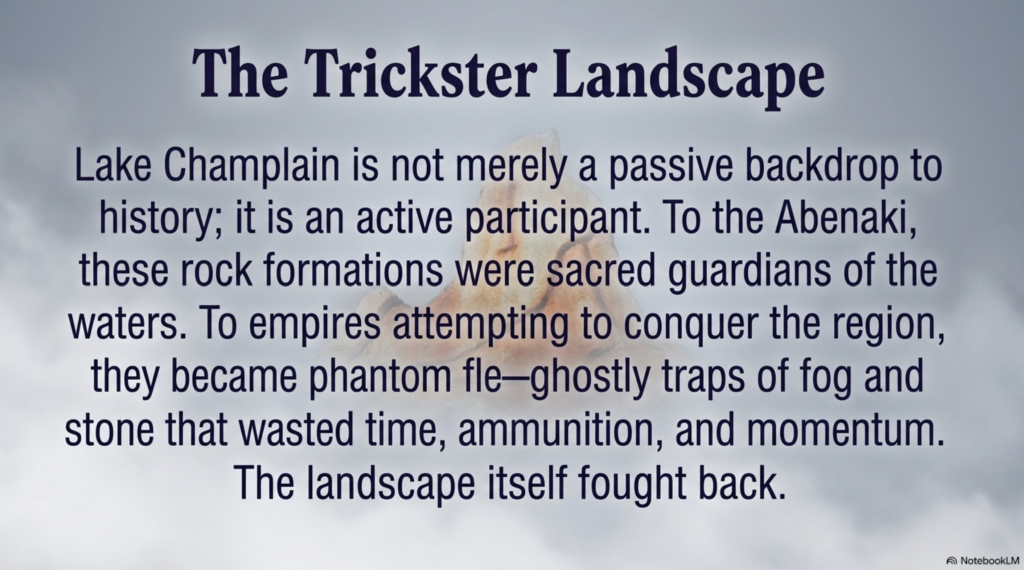
Perhaps British cannons truly battered the island while Arnold’s fleet moved farther down the lake. Perhaps islanders helped the illusion by raising makeshift masts. Perhaps the story grew with every retelling.
Whatever the precise truth, Carleton’s Prize remains one of Lake Champlain’s most memorable landmarks: an Abenaki cultural place, a Revolutionary War curiosity and a silent stone “warship” that won its battle simply by refusing to sink.
But place it in the darkness of an October morning. Cover the lake with heavy fog. Add drifting powder smoke, exhausted sailors and the expectation that an enemy vessel must be somewhere nearby. Under those conditions, the outline of a rock might become whatever frightened and determined men expected to see.