by William Alexander
For nearly seventy years, two of Lake Champlain’s oldest lighthouses stood dark.
Their lamps had been taken away. Their keepers were gone. Newer, cheaper steel towers had been built to do their work, and the old stone and iron lights were sold off like surplus government property.
Then, in the summer and fall of 2002, both of them came back to life.
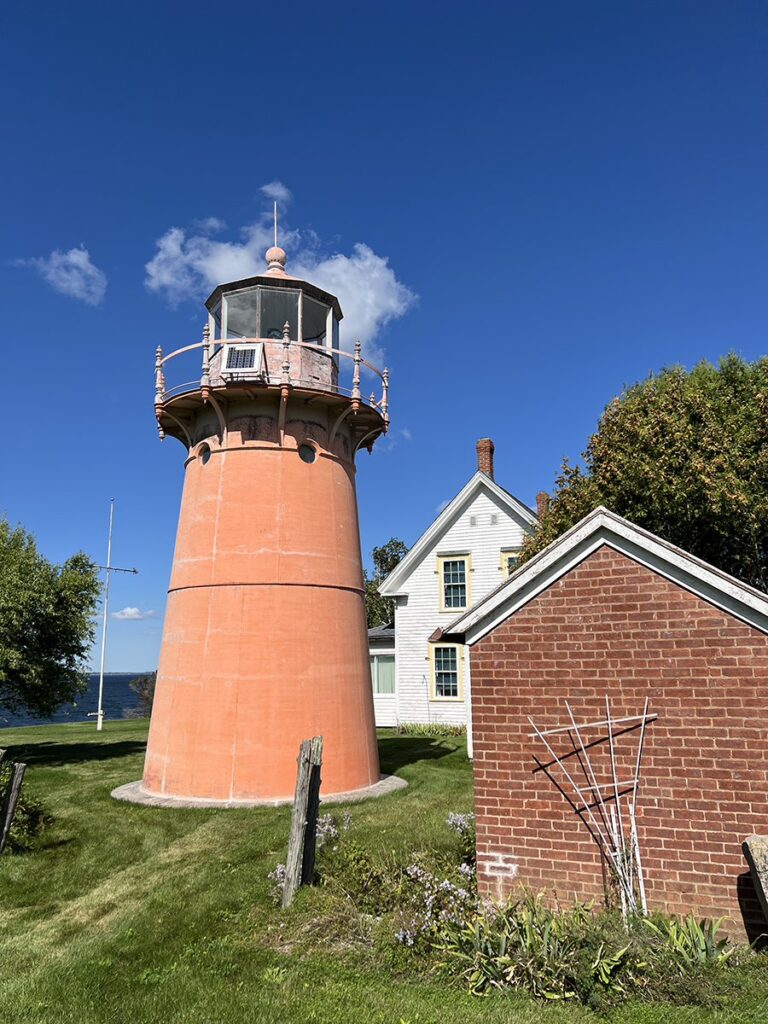
Today the Isle La Motte Lighthouse and the Windmill Point Lighthouse are working aids to navigation again, shining from the same towers that guided steamboats and lake schooners in the nineteenth century. They are about six miles apart at the very top of Vermont’s Lake Champlain, and they look nothing alike. One is a small, faded-red cast-iron cone. The other is a heavy, eight-sided tower of blue limestone.
Their stories, however, are tangled together in some surprising ways: shared keepers’ families, a navigation channel they once guarded as a team, a Prohibition-era chapter, and one Vermont family that ended up caring for both.
A Note on Access: These Are Private Homes
Both lighthouse properties are privately owned residences and are closed to the public.
Please do not enter the properties, walk across lawns or fields, approach gates, driveways or outbuildings, or try to reach either tower without the owners’ express permission. A lighthouse being historic does not make the land around it public. Local law enforcement is aware of the properties and enforces any unauthorized trespassing.
Vermonter.com intentionally gives no directions, coordinates, parking tips or “best viewing spots” for either lighthouse. Please enjoy this history from your chair and respect the people who keep it standing.
A Dangerous Corner of the Lake
By the early 1800s, Lake Champlain was a highway. After the Champlain Canal opened in 1823 and linked the lake to the Hudson River, cargoes of lumber and iron ore, along with passengers, moved up and down the water in schooners, canal boats and steamboats.
The northern end of the lake was not an easy place to do it. Reefs, shoals and winding channels near the Canadian line punished anyone who wandered off course, especially at night or in haze.
Mariners did what mariners do. They made their own lights. A private light was established at Windmill Point around 1830, most likely a lantern hung on a post, and steamboat masters were reported to be keeping temporary lights at Windmill Point and at Crown Point, New York. Those homemade beacons did the job on a clear night. In wind and thick weather, when a light mattered most, they could not be trusted.
Windmill Point: A Stone Tower for a Growing Lake
The point takes its name from an old windmill that once stood on the Alburgh peninsula. Warships had worked these waters long before any lighthouse. Benedict Arnold’s improvised American fleet operated in the northern lake in 1776, the year of the Battle of Valcour Island.
The push for a proper lighthouse came from a naval officer with a survey boat. In 1838, Lieutenant Charles T. Platt of the U.S. Navy surveyed the lake and recommended permanent lights at Windmill Point and at Crown Point, New York, noting that the rapidly growing commerce on the lake made them “indispensably necessary.” Washington, as it often did, took its time. No action followed until 1853, when pilots and mariners were consulted again and repeated Platt’s request. Congress finally set aside $8,000 for the Windmill Point light on August 3, 1854.
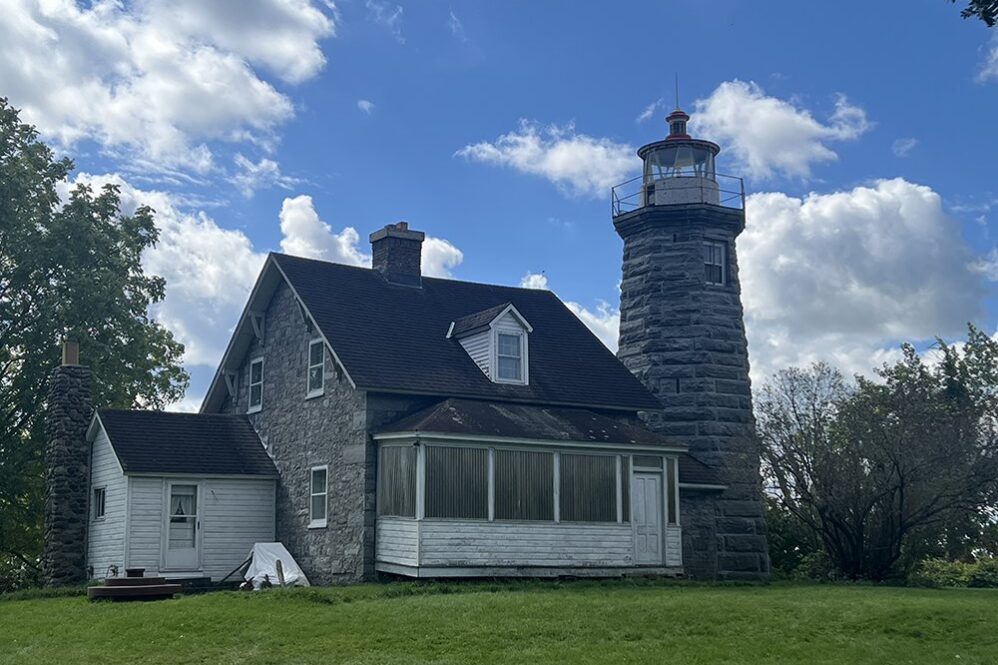
The tower went up in 1858 and entered service as navigation opened in 1859. It is an octagonal tower of blue limestone about 40 feet tall, joined by a passageway to a sturdy stone keeper’s house. Its original sixth-order Fresnel lens showed a fixed white light 52 feet above the lake, visible for up to 13 miles on a clear night.
Windmill Point has what lighthouse historians call sister lights: nearly identical stone towers built at Point au Roche, New York, and the original Crown Point station across the lake. Some accounts say the limestone for Windmill Point came from Isle La Motte’s famous quarries. Whether or not every block did, the Coast Guard lists the tower’s material as blue limestone, a stone strongly associated with that island.
Clarinda Mott, Vermont’s Only Woman Lighthouse Keeper
The first keeper of the Windmill Point light was Clarinda Mott. She was born in Alburgh, the seventh of nine children, and she was 55 years old when she took charge of the station. She kept the light from 1859 to 1862.
Lighthouse historians record Mott as the only woman known to have served as an official lighthouse keeper in Vermont. It is a small but remarkable footnote in the story of the state.
The job was never simply “turning on a lamp.” A keeper trimmed wicks, filled the lamp with fuel, polished the lens and the glass, kept the tower and house in good order, and made sure the light burned through every storm. If the light failed, a vessel might not know it was heading for a reef.
Isle La Motte: From a Lantern in a Window to an Iron Tower
The Isle La Motte light began even earlier than Windmill Point’s tower, and far less grandly. The Coast Guard dates the station to 1829, when a lantern was displayed from an upper window of a house on the island’s northern end.
In 1856 the federal government bought land for something more official, and in 1857 a lantern was mounted on top of a small stone pyramid. A local farmer was paid to light it. He did not live at the beacon, and that was the problem. On stormy nights, exactly when a light was most needed, the lamp could blow out before anyone could get there to relight it. The Lighthouse Board admitted as much in its 1868 annual report, and a small keeper’s house was added that same year.
A proper lighthouse followed. The present tower was built around 1880 and first lit in 1881. Instead of stone, Isle La Motte received a compact conical tower of curved cast-iron plates, standing about 25 feet tall on a concrete crib foundation, with its light about 46 feet above the water. It came with a detached keeper’s house and a fog bell for the days when the light alone could not cut through the weather.
Forty-Eight Years at One Light
Isle La Motte’s keeper, Wilbur F. Hill, began tending the old pyramid light in 1871. When the new iron tower was lit in 1881, he stayed on. And stayed. He kept the light until 1919, nearly half a century in all, while also running a farm.
Records note that he was praised for the condition of his station, and that in 1915 he was commended for helping three people from a disabled boat reach shore.
The Hill family threads through both lighthouses. Wilbur’s son Edward was born at the Isle La Motte lighthouse and later served as the fifth keeper at Windmill Point. Keepers’ families moved between the two stations, and the lights were bound by more than geography.
Two Lights, One Channel
The two lights also worked as a team. Lighthouse historians describe them as forming a rough range through the northern channel. By lining up the Windmill Point and Isle La Motte lights, a pilot could place his vessel on a safe track and steer clear of the reefs and shoals lying on either side.
To a captain feeling his way north on a moonless night, they were not two separate buildings. They were one set of directions.
The Lights Go Dark
The age of the resident keeper ended in the 1930s. Automatic lights on inexpensive steel skeleton towers could do the same job without a keeper, a house or a daily routine. Windmill Point was deactivated in 1931 and Isle La Motte in 1933. The old towers went dark and the stations were sold.
Windmill Point’s afterlife was an unexpected one. Its keeper’s house was transferred to the U.S. Customs Service, which used it in the fight against rum-runners smuggling Canadian liquor across the border and down Lake Champlain during Prohibition. A building that once helped honest commerce find its way now helped catch the dishonest kind.
How the Clark Family Came to Own Both
In 1949, the Isle La Motte lighthouse property came to the Clark family in a way that sounds like it was lifted from a small-town novel. A member of the family was at a dental appointment in Chazy, New York, just across the lake, when the dentist mentioned that a relative owned the old lighthouse and wondered whether her father might want to buy it. He did.
Then, in 1963, Lockwood “Lucky” Clark bought Windmill Point. Accounts say he had been showing the area to the woman he was going to marry when he met the owner. The Clark family now held both of the lighthouses that had once guided vessels as a pair. Lucky’s son, Rob Clark, would later carry that stewardship forward.
It was not a glamorous inheritance. Old lighthouses are expensive to maintain, exposed to brutal lake weather, and quiet reminders that preservation is mostly a matter of someone showing up year after year to do the work.
2002: The Lights Come Back
By the beginning of this century, the steel towers that had replaced the lighthouses were aging and costly to maintain, while the old towers were still standing. In 2001, the U.S. Coast Guard approached the Clark family about returning the navigational lights to the historic towers.
The Clarks went to work. One account estimates that Lucky and Rob Clark put in roughly 400 hours preparing the towers, fabricating parts and building mounts for modern solar-powered equipment. Since the pedestal for the Isle La Motte light had been removed years earlier, they used the one still at Windmill Point as the pattern for a new one.
Windmill Point returned to service on August 7, 2002, National Lighthouse Day, before a crowd of more than 300 onlookers. It was the first relighting of a historic lighthouse on Lake Champlain and, for the first time in almost seven decades, the lake had a working lighthouse.
Isle La Motte followed on the evening of October 5, 2002. Local schoolchildren took part in the ceremony, led by Lois Cameron, the great-granddaughter of Wilbur Hill, the same keeper who had first lit that iron tower in 1881. More than 120 years later, his family was there as the light came on again.
The Fresnel lenses and oil lamps are long gone. Modern Coast Guard optics, powered by the sun, do the work now. But the towers are the originals, and the lights shine from where they always did.
The Steel Towers and a Faded-Red Lighthouse
Once the historic towers were back in service, the skeletal steel towers were no longer needed. The one at Windmill Point was eventually removed. At Isle La Motte, the Coast Guard announced in 2014 that it was considering taking down the obsolete structure, but it ultimately remained. Today it stands as a reminder of the brief era when American lighthouses went from staffed stations to automated steel frames.
Anyone who knows Atlantic lighthouses might be surprised by Isle La Motte’s color. It is not white. The Coast Guard lists its markings as faded red, and decades of Lake Champlain weather have left the iron a soft, weathered shade that people often describe as salmon or rose. Next to the pale, solid mass of Windmill Point, it makes an unlikely pair: one small, iron and red, the other tall, stone and gray.
Respect the Lights and the People Who Keep Them
It is natural to want to see something this special up close. But historic interest does not override property rights, and these are not parks or museums. They are people’s homes.
Please do not cross gates, lawns, fields or driveways to get a better photograph. Please do not assume that because pictures of the towers appear online, the properties are open for visits. They are not.
The best thanks we can give the families who preserve Vermont history is to leave their property alone and to appreciate the lights from a respectful distance.
Two Lights That Refused to Disappear
Windmill Point’s stone tower dates to the 1850s. Isle La Motte’s iron lighthouse dates to the early 1880s. Both were replaced. Both were declared obsolete. Both went dark. And both survived.
Nearly seventy years later, each was given its job back. For modern boaters on northern Lake Champlain, they are working aids to navigation again. For the rest of us, they are proof that history does not always vanish when technology moves on. Sometimes the old light is just waiting for someone to switch it back on.
Sources and further reading
- U.S. Coast Guard Historian’s Office, Historic Light Station Information: Vermont (Isle La Motte and Windmill Point entries).
- Lighthouse Friends (Jeremy D’Entremont and Timothy Harrison): Windmill Point, VT and Isle La Motte, VT.
- New England Lighthouses: A Virtual Guide (Jeremy D’Entremont): Windmill Point and Isle La Motte histories.
- U.S. Lighthouse Society, “Light Hearted” podcast, Episode 45, featuring Rob Clark.
- National Park Service Maritime Property Inventories: Vermont lighthouses.
- University of Vermont Landscape Change Program: Isle La Motte Light and Windmill Point Light.