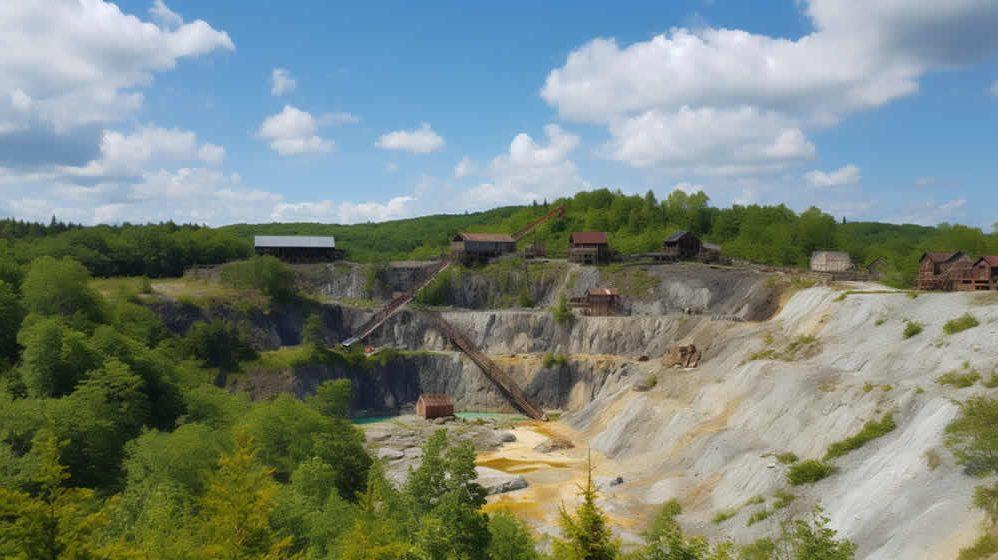
Have you ever wondered what lies beneath the green hills of Vermont? You might be surprised to learn that there is a rich history of mining in the state, dating back to the 18th century. One of the most fascinating and mysterious mines is the Elizabeth Copper Mine, located in the town of Strafford. In this blog post, I will tell you all about this amazing site and why you should visit it if you are interested in Vermont’s history and culture.
What is the Elizabeth Copper Mine?
The Elizabeth Copper Mine was first discovered in 1793 by John and Robert Ely, two brothers who were looking for iron ore. They soon realized that they had found something much more valuable: a large deposit of copper ore that was rich in sulfur and iron. The mine was named after Elizabeth Ely, the wife of John Ely and the daughter of Governor Isaac Tichenor. The mine became one of the largest and most productive copper mines in the country, producing over 50 million pounds of copper between 1809 and 1958.

- Desrosiers, Marie (Author)
- English (Publication Language)
- 96 Pages – 06/28/2021 (Publication Date) – America Through Time (Publisher)

- Explores forgotten farms, lost towns, and nature-reclaimed landmarks across Vermont, captured through photography
- From forsaken farms to lost towns, Vermont is filled with remnants of our past
- Take any winding, dirt road through the picturesque Green Mountains and you’ll soon come across a house or an old mill left to the elements
- Abandoned Vermont: Dishevelment in the Green Mountains explores these locations in depth, with photography from ten different places around the state
- Discover the debauched beauty of Elgin Springs and the tragedies of Ricker Basin

- Explores forgotten cottages, camps, and farmhouses hidden in rural mountain landscapes
- Abandoned Vermont and New Hampshire: Forgotten in the Mountains brings readers on a trip through the winding roads of mountainous areas where understated abandonment is crumbling in the small, rural areas that often get overlooked
- Along these roads, tucked away in the woods, you’ll often find cottages and camps where families once gathered for vacations, or hunters sat in front of a woodstove after a long day, but all that remains now are layers of dust and perhaps a few field mice scurrying around to break up the silence
- If you pay close enough attention on your trip through the mountains, you’ll catch glimpses of cars and trucks that haven’t moved in years, hidden behind tall, overgrown grass and weeds
- Through the photographs in this book, you’ll see once bustling family vacation areas, now still and forgotten, quietly holding all the memories that were made there

- Author Thea Lewis takes a revealing ride through the unique and colorful history of the Green Mountain State
- Vermont is a picturesque landscape, but the idyllic setting hides a sometimes dark and desperate past
- H
- H
- Holmes, America's first serial killer, may have been the University of Vermont's deadliest student
The Elizabeth Copper Mine was also a source of innovation and controversy
It was the first mine in the world to use steam engines to power its machinery, and it employed hundreds of workers from different countries and backgrounds. It also faced many challenges, such as floods, fires, strikes, lawsuits, and environmental issues. The mine was eventually abandoned in 1958, leaving behind a legacy of pollution and health problems for the nearby residents.
The Elizabeth Copper Mine is not just a pile of rocks and rubble. It is a hidden gem of Vermont’s history that tells a story of human ingenuity, ambition, and struggle. It is also a place of natural beauty and wonder, where you can see the traces of the geological forces that shaped the land and the mineral wealth that attracted people to it. If you want to learn more about this fascinating site and how it influenced Vermont’s culture and economy, you should definitely visit it or read more about it online.
The Discovery and Development of the Elizabeth Copper Mine
The story of the mine began in 1793, when a young farmer named John Taylor stumbled upon a greenish rock while plowing his field. He took it to a nearby town, where a chemist identified it as copper ore. Taylor realized he had found a valuable resource and decided to explore the land further. He soon discovered a rich vein of copper that extended for miles under the ground.
Taylor began mining the ore in 1809, with the help of his family and some hired workers. He built a small furnace to smelt the copper and sold it to local merchants and manufacturers. The mine quickly became profitable and attracted the attention of other investors and entrepreneurs. By 1820, the mine was producing about 200 tons of copper per year and employed over 100 people.
- Alexander, William M. (Author)
- English (Publication Language)
- 74 Pages – 08/26/2018 (Publication Date) – Independently published (Publisher)

- A look back on the riveting history of Vermont, featuring stories from the American Revolution and the summoning of spirits
- Vermont's history is marked by fierce independence, generosity of spirit and the saga of human life along its steep slopes and fertile valleys
- Meet the widow who outwitted Tories and may have spied for the Green Mountain Boys
- Encounter the family who gained a national following by summoning spirits
- Discover why one governor opposed women's suffrage and how that may have involved spirits of another sort

- Vermont
- Who Knew? is a nonfiction travel book, including both serious and humorous content
- It comprises nine chapters–one with a state-wide focus and eight regional chapters
- Explores forgotten cottages, camps, and farmhouses hidden in rural mountain landscapes
- Abandoned Vermont and New Hampshire: Forgotten in the Mountains brings readers on a trip through the winding roads of mountainous areas where understated abandonment is crumbling in the small, rural areas that often get overlooked
- Along these roads, tucked away in the woods, you’ll often find cottages and camps where families once gathered for vacations, or hunters sat in front of a woodstove after a long day, but all that remains now are layers of dust and perhaps a few field mice scurrying around to break up the silence
- If you pay close enough attention on your trip through the mountains, you’ll catch glimpses of cars and trucks that haven’t moved in years, hidden behind tall, overgrown grass and weeds
- Through the photographs in this book, you’ll see once bustling family vacation areas, now still and forgotten, quietly holding all the memories that were made there

- For many Americans, Vermont still seems what the United States at least in myth once was–a bucolic landscape of wooded hills, neat farms, and handsome villages–before modern forces transformed our agrarian nation into an urban-industrial giant
- Vermonters have long been respected as sturdy Americans who prize hard work, honest dealing, town-meeting government, and dry humor
- Their way of life, along with the beauty of their Green Mountains and quiet valleys, remains immensely attractive to natives and newcomers who seek beauty and the satisfaction of self-sufficiency in a natural environment where rocky soil and a varied climate have always compelled respect
- Desrosiers, Marie (Author)
- English (Publication Language)
- 96 Pages – 06/28/2021 (Publication Date) – America Through Time (Publisher)

- From a cross-border Confederate attack to the underdressed men from Maple Corner, It Happened in Vermont looks at intriguing people and episodes from the history of the Green Mountain State
- Learn why a militia sent to defuse a dangerous mob of striking miners ended up handing out their own rations
- Read about the shocking “ball of light” that descended upon early twentieth-century Burlington, exploded—knocking a horse senseless—and then rapidly shot back up into the sky
- Follow two of America’s founding fathers as they traveled through the state, revelling over the region’s flora and fauna and recording their impressions of its residents
- Discover what caused “the year without a summer,” when trees turned black and crops fell victim to intermittent hard frosts and snowstorms interrupted by short intervals of intense heat and droughtRelive the terrible flood of 1927 that wreaked havoc in communities along the Winooski River and its tributaries, killing eighty-two people and washing away homes, bridges, and railroad tracksMark Bushnell worked for a dozen years as an editor for Vermont newspapers, then turned to freelance writing in 2002
The mine faced many challenges and difficulties over the years
The ore was hard to extract and required advanced machinery and techniques. The workers had to endure harsh conditions and long hours in the dark tunnels. The mine also faced competition from other mines in the region and abroad. The price of copper fluctuated depending on the demand and supply. The mine had to adapt to changing markets and technologies, as well as environmental and social issues.
Despite these challenges, the mine also achieved many successes and innovations. The mine was one of the first to use steam engines, railways, and telegraphs to improve its operations and efficiency. The mine also contributed to the development of the local community and economy, providing jobs, education, and infrastructure. The mine was also a source of scientific and artistic inspiration, attracting geologists, engineers, historians, and painters who studied and depicted its features and history.
The mine produced over 4 million tons of copper in its 148 years of operation, making it one of the largest and longest-running copper mines in the world. The copper extracted from the mine was used for various purposes, such as making coins, wires, pipes, utensils, jewelry, and art. The copper also played a role in important historical events, such as the Industrial Revolution, the Civil War, and the World Wars.
The mine closed in 1957, due to declining profits and reserves. The site was then converted into a museum and a heritage park, where visitors can learn about the history and legacy of the mine and its workers.
The Environmental Impact and Remediation of the Mine
Hey, do you know what acid mine drainage is? It's a nasty problem that happens when water reacts with rocks that have a lot of sulfur in them, like pyrite. The water becomes acidic and full of metals, and it can pollute rivers and harm wildlife. That's what happened at the mine site we're studying.
The mine was active for a long time, but it was abandoned in the 1980s. The water kept flowing out of the mine and into the nearby river, turning it orange and killing fish. The river also feeds into a larger watershed that provides drinking water for millions of people. That's why the mine became an EPA Superfund site in 2001. That means it's one of the most contaminated places in the country and needs a lot of cleanup.
The cleanup efforts have been going on for over 20 years now, and they involve a lot of different steps. Some of them are: pumping and treating the mine water, capping and re-vegetating the waste rock piles, installing drainage systems and barriers to prevent runoff, monitoring the water quality and ecological health, and educating the public about the risks and benefits of the project.
The goal is to restore the mine site to a more natural state and protect human health and the environment. There are some benefits to doing this, such as creating jobs, improving recreation, enhancing biodiversity, and reducing greenhouse gas emissions. But there are also some challenges, such as high costs, technical difficulties, legal issues, and social conflicts.
The Cultural and Historical Significance of the Elizabeth Copper Mine
The mine is more than just a source of minerals and metals. It is also a rich repository of stories and legends that reflect the lives and culture of the people who worked there and the communities that surrounded it. Some of these stories are factual, some are fictional, and some are somewhere in between. But they all reveal something about the mine and its impact on Vermont.
One of the most famous stories is that of the Green Mountain Boys, a militia group that fought for Vermont's independence during the American Revolution. According to legend, they used the mine as a secret base and a supply of gunpowder. They also allegedly hid a treasure of gold and silver coins in one of the mine's tunnels, which has never been found.
Another story is that of the ghost of Tommyknocker, a mischievous spirit that haunts the mine and plays pranks on the miners. Some say he is the ghost of a miner who died in an accident, others say he is a mythical creature from Celtic folklore. Either way, he is said to warn the miners of impending danger by knocking on the walls or making noises.
If you want to experience the mine site today, you have several options. You can also explore the mine at your own risk by following marked trails and signs. For more stories about abandoned mines in Vermont, take a look at the Lowell Asbestos Mine article.
The mine is not only a part of Vermont's past, but also its present and future. It is a valuable asset for education, tourism, recreation, and conservation. It preserves a unique heritage and culture that deserves to be celebrated and shared. The mine is a testament to the courage, ingenuity, and resilience of the people who worked there and shaped Vermont's history.
Thank you for visiting Vermonter.com! Please subscribe to our email list for the latest articles!