The Town of Barton was first granted by the legislature in response to a petition from some sixty Revolutionary War veterans
… in 1781 under the name “Providence” after their home town in Rhode Island, but was not chartered until October 20, 1789. In the intervening years, the number of grantees dropped to only 29, one of whom was Ira Allen, who was assigned 19/70 of the whole town. Another grantee was the first American naval hero, John Paul Jones, although he never took up residence in Barton.
At the time of the charter, the town was named Barton most likely after one of the original grantees, Gen. William Barton, who apparently did settle in this new town, but did not bring his family to live with him. It is thought that he moved there to speculate land. His family remained in Rhode Island and he eventually returned there for the last years of his life.
The first permanent settler was Asa Kimball who came alone to Barton in 1794 to make a clearing and then brought his family the next summer, whereon he raised about fifty bushels of grain, the first harvest ever in Barton. He opened a public house (pub) soon after his arrival and ran it the whole time that he lived there. Apparently, Kimball had the urge of a wanderer because he later moved to New York state and finally on to Ohio, where he died in the 1820's.
There are now two incorporated villages in the Town of Barton, Vermont
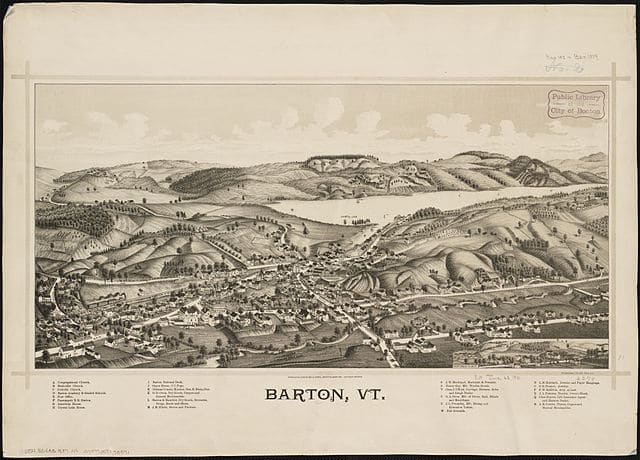
Barton Village was incorporated on November 21, 1874. (Baldwin, 1921) It is located at the outlet of Crystal Lake a little bit south of the central part of the town's boundary. The second is Orleans Village, found at the northern corner of the town on Barton River incorporated in the first half of the 19th century. (Child, 1883)
Runaway Pond
Before 1810 much of the land area that is now Orleans was part of a pond now called Runaway Pond, that broke unexpectedly and flooded areas to the north. (See Section B. Natural Resources, Bodies of Water) Originally called Barton Landing because of its location on the river (a spot that was used during smuggling in the early 1900's and previously by people of the St. Francis, Coosuck, and Abenaki tribes as an encampment along a migration route through New England), the name was changed to Orleans Village in 1908. The issue of the name came about when the Boston and Maine Railroad management suggested through an article in the Monitor, the local newspaper, that the name was confusing for train dispatchers because there were also stops in Barton and South Barton. Letters to the editor suggested names like Indian Landing, because of the origin of the name Barton Landing, or Chandler, which was the family name of the original founders of the lumber company that helped make the village so prosperous.
After some months of private and public discussion the villagers approved the name Orleans, the same name as the county. The village voted in the new name of Orleans on December 11, 1908, and the village of Barton Landing officially became the village of Orleans on January 1, 1909.A third settlement occurred in the southeasterly portion of Barton. Originally known as South Barton, it has gone by the names Willoughby, Kimball, and Jacksville as well.
How Barton, Vermont got its name
Swift reports that Barton is a common place name in England. In Old English, Barton meant, “a grain or corn farm” and gradually came to be used to mean an outlying grange, or kind of demesne farm, often belonging to a monastery. Barton, Vermont is named for Colonel (later General) William Barton, best known for having captured the British commanding General Robert Prescott, at Prescott's Rhode Island headquarters in 1777. Prescott's capture lessened the pressure on American General George Washington's forces in New Jersey. Barton's namesake, General William Barton, later spent fourteen years in jail in Vermont for refusing to pay a public fine, although people that knew him believed he could have easily paid for it.
Historical Highlights
1791 – About 60 Revolutionary War veterans from Providence, R.I., request a charter for land in Vermont, asking that the town be named Providence. When the charter was granted eight years later, the first named grantee, Colonel William Barton changed the town's name to Barton. 1794 – The town's first permanent settler, Asa Kimball, came alone in 1794 to make a clearing. He brought his family the following summer, whereon he raised 50 bushels of grain, the first ever harvest there. He also opened the first tavern and was moderator of the first town meeting. Apparently he had the urge to wander, for he later moved to western New York state and finally on to Ohio where he died in the 1820's. (Swift) 1951 – Lee E. Emerson of Barton elected governor of Vermont and served at this post until 1955. 1987 – A softball sized meteorite fell in Barton. It was the first meteorite found in Vermont. After it thawed, it turned into a pile of sand, pulverized rock and iron fragments.
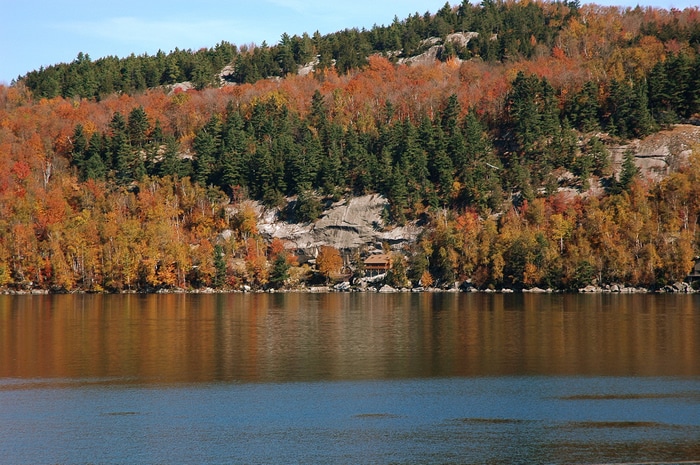
Barton's Crystal Lake…
is approximately three miles long and about one mile in width. The 778-acre deep cold waters are excellent habitat for rainbow trout, lake trout, yellow perch, chain pickerel, small mouth bass and pan fish. Crystal Lake boating opportunities, including boat rentals, are available. Outdoor enthusiasts enjoy fishing, picnicking, a playground and swimming.
Are there any connections between the Ku Klux Klan in Vermont and the history of Barton, VT?
Yes, there is an interesting and in-depth ku klux klan vermont article that explores the connections between the Ku Klux Klan in Vermont and the history of Barton, VT. The article uncovers the Klan's presence in the area and delves into the historical context of Barton, VT during that time period.
What Role Did Barton, VT Play in the History of the Vermont 251 Club?
Barton, VT played a significant role in the history of the Vermont 251 Club. As one of the 251 towns and cities within the state, Barton, VT has contributed to the rich history and culture that is celebrated by the members of the Vermont 251 Club.
Barton Vermont History
In 1759, during the French and Indian War, Roger's Rangers were chased into the Crystal Lake – Barton area, according to the history books. It is believed that Robert Roger was familiar with this area at the age of fifteen and that he participated in and helped lead the raid on St. Francis in Canada.At one time, there was a granite quarry on the east side of Crystal Lake. Near the turn of the century, steamboats barged stones across the lake. Crystal Lake park's beach house was made of granite quarried beside the lake. It was constructed in the late thirties by the Civilian Conservation Corps. It has a very unusual architectural design and received prominent recognition the year it was built.
Crystal Lake State Park
… offers almost a mile of sandy swimming beach, a large granite bathhouse with flush toilets, changing areas and a concession stand. Picnicking opportunities include 40 free standing charcoal grills, nearly 80 picnic tables, a playground and lots of parking space. Fishing is thoroughly enjoyed at Crystal Lake. The deep cold waters offer an opportunity to catch rainbow trout, lake trout, yellow perch, chain pickerel, small mouth bass and pan fish. Cross-country skiing permitted in winter by walking around entrance gate; all facilities closed including restrooms.
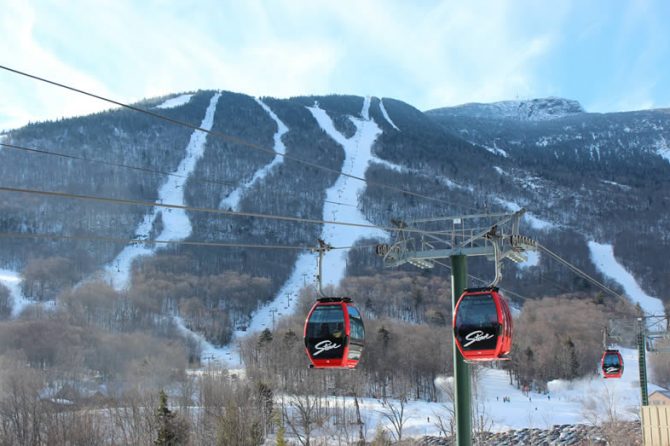
Nearby attractions include Jay Peak Gondola, Jay; Burke Mountain Toll Road and fire tower, E. Burke; Historical Granite School, Brownington and Ethan Allen Furniture, Orleans. Late Summer events include the Orleans County Fair.
Local Personalities
John Baptiste Masta M.D., a local eminence at his death at 42 in 1861, lay obscured by history until Robin Tenny, town historian, uncovered his record and had contact with the doctor's descendants in Massachusetts. They conducted two projects. First they straightened and cleaned Masta's grave, a handsome white six-foot column at Barton's Welcome O. Brown Cemetery (where also lies his wife, Emeline Buleigh Quimby of Lyndonville and three of their four children, who died young), and then they tried to locate a handsome two story house they believed must have been the Masta's home in Barton. Although they had no luck locating the home, they have found that Masta lived in a home purchased from one Pierce, on the northwest corner of Main Street and Congress Court, northeast at the center of Barton Village. The site is now occupied by the Congress Court apartments for the elderly.
John Baptiste Masta was born in 1819 in the Parish of St. Francis, Lower Canada (now Province of Quebec). In 1838 he came to the US to study English. While he lived, it was no secret that he was part Abenaki, although later this fact was buried. His nephew Henry Masta, son of Dr. Masta's brother Ignace, was for a time the presiding Chief of the Abenaki at St. Francis and teacher at Dartmouth School on the reservation. John Baptiste walked to Dartmouth College to attend, following the lead of his older half-brother, Peter Paul Osunkhirhine, who began this family tradition by going to Dartmouth in 1822. Dartmouth was set up to educate Native Americans. They were treated kindly there and given lots of work. “…there was a fund for them as well as a lot of menial labor.” John Baptiste finished medical school at Dartmouth and ended up in Barton.John Baptiste attended Dartmouth from 1839 to 45 and from 1847 to 50. President Lord did not consider him intelligent enough for a college training. He returned, however, in 1847 to the Medical School, and received the M.D. Degree in 1850. He practiced in Barton and died in 1861. (Chris Braithwaite, “Looking Back: A skillful physician and a good man”, The Chronicle, Section B, 11/9/94)
Dennis Taylor, a saxophone player from Barton, is now living in Nashville, TN. He received the unusual honor of being on a stamp cancellation, (that set of wavy lines, with a date, stamped right across the top of the envelope). In this case, the cancellation includes a profile of Mr. Taylor playing the sax. Dennis got his musical start in Barton like 100's of other kids who have taken music lessons through the school. After teaching music at Johnson State College, he moved to New Orleans to launch his new career. He has lived in Nashville since 1990 and gives lessons to underprivileged children. He plays all kinds of music, but leans towards jazz and the blues. His parents are Ad and Lois Taylor. (The Chronicle, 11/23/94:3)
Emory A. Hebard. Barton (Glover?) was home to the legendary Emory A. Hebard, who served as the Vermont State Treasurer for 12 years. Emory was born in Carmel, Maine on September 28, 1917 and died on November 1, 1993 at the age of 76 following complications from a heart attack. He also served for 16 years in the Vermont House of Representatives, beginning in 1960 and serving on the two most powerful money committees, the Ways and Means Panel and the Appropriations Committee. Using the slogan, “Thrift is still a virtue” he ran in 1976 for State Treasurer. Emory appeared to be what he was, a small town store owner, but he had an unusual, razor sharp mind, adept at understanding world finance. Few knew that he was a Phi Beta Kappa graduate from Middlebury College in 1938, or even that he subsequently worked for an agency of FDR's New Deal in Washington, D.C. Born in Maine, he came to Vermont first to attend Middlebury and graduated in 1938.
He served as a Lt. Commander in the US Coast Guard from 1942-45 during WWII, and from 50-52 during the Korean Conflict. He owned and operated Emory's Country Store in E. Charleston from 1947 to 50 and Emory's Country Store in Glover from 1952 to 63. He also served as the E. Charleston postmaster. When Chris Braithwaite opened the Chronicle in 1973, Emory gave him the advice that “You'll get to handle a lot of money, but you won't get to keep any of it.” Emory also wrote to Chris, “Why not let motorcyclists ride without helmets, as long as they would sign a release promising that they would never ever rely on tax dollars to cover medical expenses, if they bash their brains out against a bridge abutment?”
He married Irma Mills on March 30, 1941. She died on April 11, 1992, and on September 25, 1993 he married Edith Cameron, who survives him. Also surviving him are his daughter Sammy, her husband Colonel Wendel Ryan of Williston and their children, Major Matthew Hedger of Japan, Sarah English of Boston, and Adam Hedger of South Burlington, and his brother Reverend Alden Hebard of Des Moines, Iowa, and four great grandchildren. He is buried at Westlook Cemetery in Glover.
Emory was a Republican in the Vermont tradition (a philosophy of independence shaped by U.S. Senators Ralph Flanders, Warren Austin, George Aiken, and Governor Dean Davis) with a strong sense of bipartisanship. Regarding the court ordered move in the 1960's requiring the state to reapportion the House, ending the one-town, one-vote system that had favored rural communities, he said “It's the worst thing that happened to the State of Vermont.” He then led the 1965 reapportionment that swept away Vermont's one-town, one-vote House of Representatives. He told the House, “better do the job ourselves and keep the courts out of it”. In 1979, the legislative committee tried to give Emory a 11% salary increase. As state treasurer, he refused, saying that elected officials shouldn't receive more than rank-and-file workers, whose pay was going up 5.5% that year.
Mary Baker Eddy, the founder of the Christian Science Religion, established in 1892, stayed in Barton for a while just after her second husband died more than 100 years ago. She turned to a former student whom she had sent to Cincinnati to teach and practice Christian Science, Arthur True Buswell. He was a doctor in Barton at the time of her visit, living on West Street, known to many as Cemetery Hill. Mrs. Eddy journeyed to Barton in July of 1882 and stayed where is now the home of Marsha Cloutier. Apparently she left in the fall. She lectured about the origins of Christian Science to a local group. (The Chronicle, 8/9/95)
Leland “Lee” Kinsey, a poet, also makes his home in Barton. Born around 1950, married, with a son (b. 1986) and a daughter (b. 1992), Kinsey was raised on his family's hill farm near Albany. Kinsey majored in English at UVM, graduating in the early 1970's. He received an MA from Syracuse in the mid 70's. Kinsey has taught poetry at 70+ schools as part of the Artists-in-the-schools program of the VCA. He tries to write every day. He writes articles and short stories, teaches birding, canoeing, poetry and autobiographical writing at a local Elderhostel. His poems depict rural life, Vermont farming, cutting wood, quiet bitter cold places, tales of sledding and haying, and always, death. A four part poem of his is titled “The Fire on a barn fire, father and son”. “His poetry explores the forces of change, the seasonal events of rural life in Vermont's backwoods serving as the vehicle for his reflections on how change feels from the inside.” “Kinsey's commitment to life in the Northeast Kingdom gives this book an authenticity that's worth savoring.” (Sarah Seidman (Middlesex) in TA Country Courier. 9/17/93). Kinsey's second book of poetry is Family Drives, published by New England Press in 1993. His first collection is Northern Almanac published by Catamount Arts Press in 1991.
John Meehan and his wife Sharyn also of Barton briefly threw their hats in the ring for U.S. Presidential Campaign in 1992. They are the former operators of the Canterfield Farmstand who, in 1991, waged a long bitter fight with the village over zoning requirements surrounding its sign. They also launched a farm advocacy group called American Free Farmers in 1991. John Meehan was the only one elected as town trustee in the spring of 1993 because no one wanted to run for the seats, and the previous three trustees had all resigned. Barton was threatened with being the first town in the state to have no trustees. Meehan suggested that it was time the village considered hiring a manager because running the electric, water, sewer, and street departments demands too much time to be done on a volunteer basis. The towns people were considering hiring one manager for both Orleans and Barton Villages as well as for the town.
Note: This series is available courtesy of the Center For Rural Studies, a nonprofit, fee-for-service research organization which addresses social, economic, and resource-based problems of rural people and communities. We would like to thank them for the use of this information and would like to refer you to [email protected] for additional info or comments.
Thank you for reading this post, don't forget to subscribe to our email list for the latest news!